Javascript Do While Wait and Try Again
How to Make JavaScript Slumber or Wait
JavaScript does not have a sleep() function that causes the code to wait for a specified period of time earlier resuming execution. And so what practise y'all do if you need JavaScript to look?
"In computing, sleep is a command in Unix, Unix-like and other operating systems that suspends program execution for a specified time." — Wikipedia
Let'southward say you want to log three messages to Javascript's panel, with a delay of one 2nd betwixt each one. At that place's no sleep() method in JavaScript, and so you try to use the next best thing, setTimeout().
"The
setTimeout()method of theWindowOrWorkerGlobalScopemixin (and successor toWindow.setTimeout()) sets a timer which executes a function or specified slice of code once the timer expires." — MDN Docs
Unfortunately, setTimeout() does non work quite every bit you might expect, depending on how you apply it. You may have tried information technology at some signal in a JavaScript loop and seen that setTimeout() seems to not work at all.
The problem arises from misunderstanding setTimeout() as a sleep() office, when it really works according to its own set up of rules.
In this article, I explicate how to utilise setTimeout(), including how you can utilize it to brand a slumber role that will crusade JavaScript to suspension execution and wait between successive lines of code.
If y'all simply quickly skim the setTimeout() docs, it seems to have a "delay" parameter, measured in milliseconds.
Going dorsum to the original trouble, you attempt to call setTimeout(1000) to wait for 1 second betwixt your calls to the console.log() function.
Unfortunately setTimeout() doesn't piece of work that way:
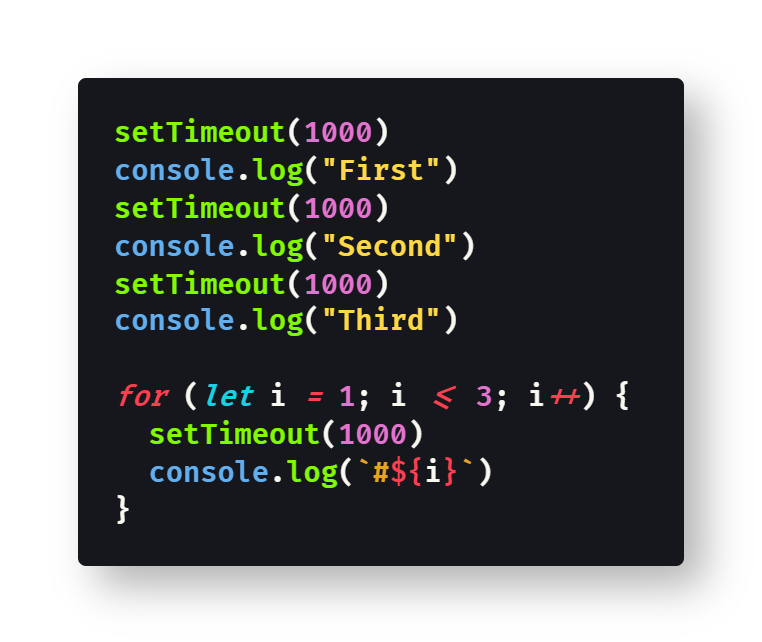
The outcome of this code is no delay at all, as if setTimeout() didn't exist.
Looking back at the docs, you lot realize that the problem is that the get-go statement is actually supposed to be a office phone call, non the delay. Afterwards all, setTimeout() is not actually a sleep() method.
You lot rewrite your code to have a callback function as the kickoff argument and the requisite filibuster every bit the second parameter:
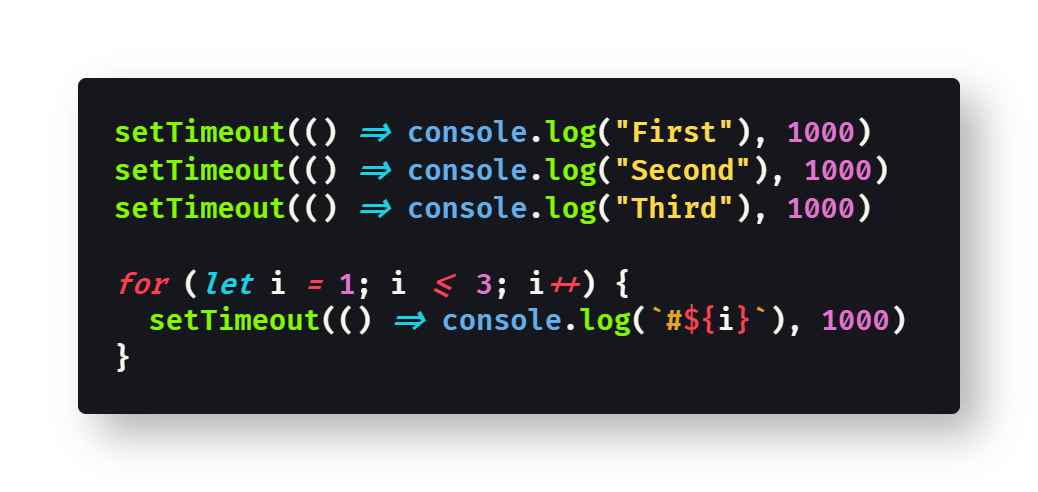
This results in all three panel log messages being displayed together, after a unmarried delay of 1000ms (1 second), instead of the desired effect of a filibuster of ane second between each repeated call.
Before nosotros talk almost how to fix the issue, let's examine the setTimeout() function in a little bit more detail.
Examining setTimeout()
You may take noticed the employ of arrow functions in the 2d code snippet above. Those are necessary because you need to laissez passer an anonymous callback part to setTimeout() that will run the lawmaking you want executed after the timeout.
In the bearding function, y'all can specify any arbitrary code to be executed later on the timeout menstruum:
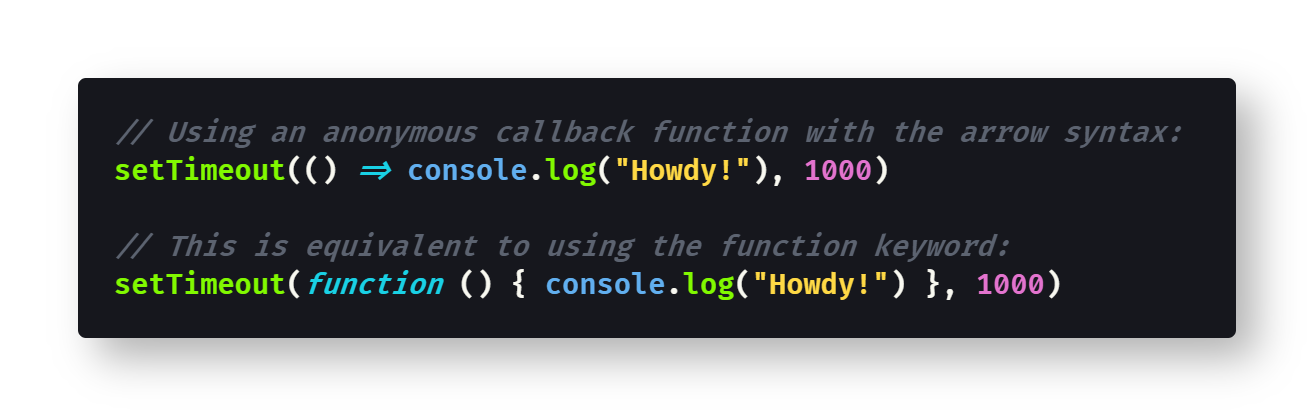
Theoretically y'all can just laissez passer the function every bit the get-go argument, and the arguments to that callback function equally the remaining parameters, just that never seems to piece of work right for me:
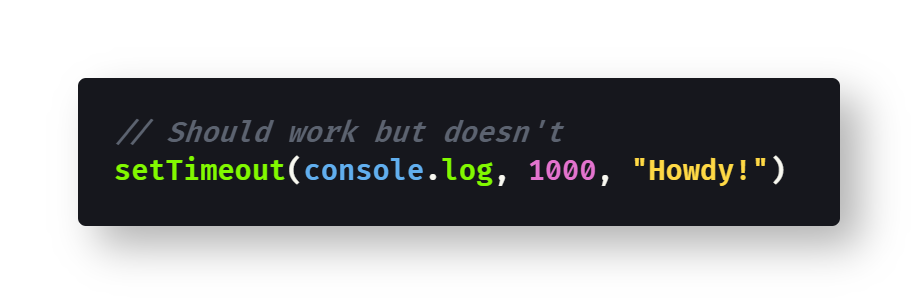
People work around this using a string, but that is not recommended. Executing JavaScript from a string is a security risk, due to the fact that any bad player could run arbitrary code injected as a string.
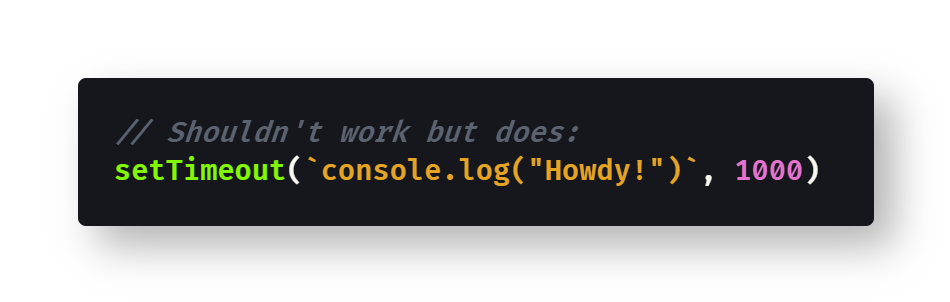
So why did setTimeout() fail in our starting time prepare of lawmaking examples? It seems like we were using it correctly, with a repeated delay of 1000ms each fourth dimension.
The reason is that setTimeout() is executed as synchronous code, and the multiple calls to setTimeout() all run at the aforementioned time. Each call to setTimeout() creates asynchronous code that will execute after, after the given filibuster. Since each delay in the code snippet was the same (1000ms), all the queued code runs at the same time, after a single delay of ane 2d.
As noted, setTimeout() is non actually a sleep() part; instead, it only queues asynchronous code for later execution. Fortunately, it is possible to utilize setTimeout() to create your own sleep() office in JavaScript.
How to Write a Sleep Function
Through the ability of Promises, async, and await, y'all can write a sleep() function that volition piece of work as you would look it should.
However, you tin only call this custom sleep() office from inside async functions, and you lot demand to utilise the await keyword with it.
This code snippet demonstrates how to write a sleep() office:
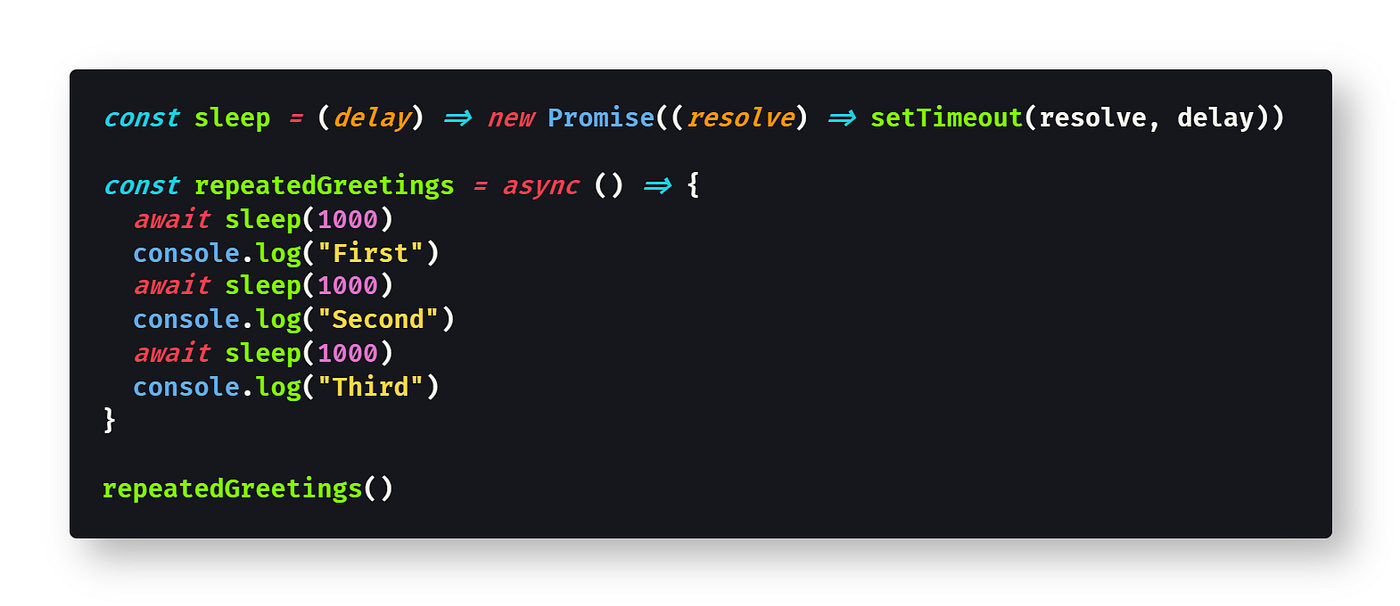
This JavaScript sleep() role works exactly as you might expect, because await causes the synchronous execution of the code to pause until the Promise is resolved.
A Simple Alternative
Alternatively, y'all can specify increasing timeouts when you telephone call setTimeout() in the first place.
The following code is equivalent to the last example:
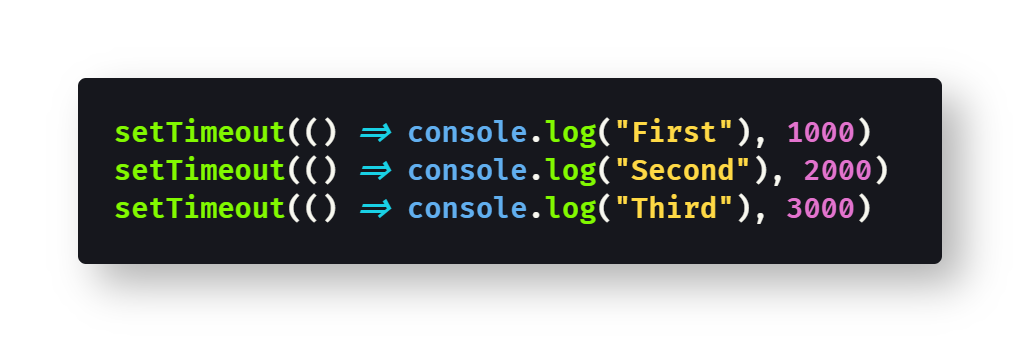
Using increasing timeouts works because the code is all executed at the aforementioned fourth dimension, then the specified callback functions will be executed 1, ii, and 3 seconds from the time of the execution of the synchronous lawmaking.
Personally, I like this method a lot, though you tin't create a sleep office that works this mode without tracking (or guessing) what the timeout should exist using some blazon of variable.
Will It Work In Loops?
Either of the above options to suspension JavaScript execution will piece of work fine in loops, as you lot might expect. Allow's expect at two quick examples.
Hither's a code snippet using a custom slumber() function:

And here is a code snippet with the simpler employ of increasing timeouts:
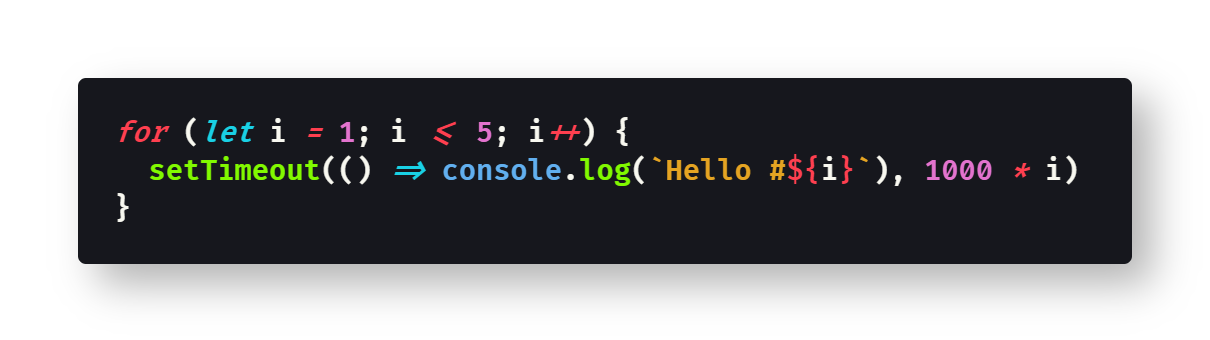
Once more, I prefer the latter syntax, particularly for use in loops.
Conclusion
JavaScript may not have a sleep() or wait() part, simply it is piece of cake enough to create i using the built-in setTimeout() function — every bit long as you are careful with how you employ it.
Past itself, setTimeout() does not piece of work equally a sleep() function, simply you tin create a custom JavaScript sleep() function using async and await.
Taking a dissimilar approach, you can pass staggered (increasing) timeouts to setTimeout() to simulate a sleep() function. This works because all the calls to setTimeout() execute synchronously, merely similar JavaScript usually does.
Hopefully this helps you introduce some delay into your lawmaking — simply using vanilla JavaScript, without any demand for external libraries or frameworks.
Happy coding! 👍💻🔥😊🖖
crutcherthationdeas51.blogspot.com
Source: https://blog.devgenius.io/how-to-make-javascript-sleep-or-wait-d95d33c99909
0 Response to "Javascript Do While Wait and Try Again"
Post a Comment