How to Capture and Read Ssl Traffic
When using Wireshark to monitor web traffic, you'll find that a lot of the traffic is encrypted. Today, we're looking at how you can decrypt SSL using Wireshark.
Virtually sites these days are using SSL or TLS (Transport Layer Security) encryption to brand sure their users stay safe. Unfortunately, although encryption is proficient for y'all when browsing Reddit, it can be quite a hassle for network administrators.
About Wireshark And SSL
Wireshark
Wireshark is a well-known network traffic assay tool. A lot of network administrators use it to help them with troubleshooting. The tool volition take snapshots of frames, letting you lot sift through and analyze them individually. Oft, information technology's used in tandem with another network monitoring tool. Usually, one that provides higher complexity, only read near that in our terminal section!
Wireshark helps network admins take a closer wait at the traffic going through their network; y'all tin can see inside the frames that brand upward each packet and take a expect at the raw data behind them.
SSL
SSL or Secure Sockets Layer is an encryption protocol working on the Transport layer of the OSI model. This protocol uses multiple different encryption methods to ensure that information is secure when traveling through networks.
SSL has a successor, TLS or Transport Layer Security, that does its task amend in almost situations. So we'll be using SSL to refer to both of these at in one case.
Why Does SSL Make Using Wireshark Harder?
SSL encrypts information traveling from network to network, which prevents the network administrator from looking at the data within each packet. With that being said, Wireshark tin can decrypt SSL then that you can wait at the information once more.
Taking Advantage of Pre-Master Keys
The easiest mode to decrypt SSL using Wireshark is by taking advantage of pre-master keys.
The client generates a pre-master key then uses the server to derive a master key, encrypting the traffic. This is today's cryptography standard and is generally implemented through Diffe-Hellman fundamental exchange.
Yous can set the browser up to log the pre-master key, which volition and so let Wireshark employ information technology to decrypt SSL.
So, how do you practise this?
- Set an surround variable from Avant-garde System Settings in Windows
- Double-click on the browser of your pick
- Set upwards Wireshark
- Outset capturing and decrypting session keys
These four steps will let you to decrypt SSL without needing to admission the target server.
one. Setting An Environment Variable
You lot can set the environment variable you need by accessing Advanced Organisation Settings. The variable in question is SSLKEYLOGFILE, and information technology has a path containing the storage location of the pre-primary keys.
- Right-click on My Computer
- Get to "Properties," opening the System menu
- Click on "Advanced System Settings"
- Go to the "Advanced" tab, and click "Environment Variables"
- Click on "New" in the User Variables section. If you'd like to log SSL keys for all platform users, you can create this variable in the System Variables section instead.
- Give it the post-obit Variable Name: SSLKEYLOGFILE
- Inside the "Variable Value" section, write the path to your log file. Alternatively, you can click the browse file button and simply pick one.
With that being said, if you're creating an environment variable for the whole system, then you'll need to use the right wildcards or have the file in a place attainable past all users. Occasionally, you might need to restart your device before the organization registers the Environment Variable.
Setting An Environment Variable in Mac or Linux
Linux and Mac brand it a fleck harder to gear up the SSLKEYLOGFILE environment variable. Then nosotros'll have to apply nano for it. On Linux systems, this variable volition be stored in ~/bashrc. In example you're using a Mac device, you should look in ~/.MacOSX/surroundings.
In Linux and Mac, you'll need to fix the SSLKEYLOGFILE environment variable using nano. In Linux, the variable is stored in ~/.bashrc. On the Mac, y'all'll create the variable in the file ~/.MacOSX/environment
- On Linux, open upwardly the last; on Mac, open up up Launchpad and launch a concluding.
- Run the command nano ~/.bashrc on Linux or nano ~/.bash_profile on Mac
- Add a final line: "export SSLKEYLOGFILE=~/.ssl-cardinal.log"
- Save your changes
- Close your terminal and then open up it once again. Write the "echo $SSLKEYLOGFILE" command to make sure y'all've set it correct.
- Yous should run into the path to your SSL pre-master cardinal log on the screen. Make a note of this path as it'll be helpful for you in the future.
This is all you demand to do to gear up the variable, and now we tin can motility on to further steps.
2. Await For The Log File In Your Browser
Before y'all start up Wireshark and go to decrypting SSL, y'all'll demand to ensure that your browser uses your log file.
First, you'll want to visit a website that has SSL enabled. It doesn't matter what website this is, as you just need to meet i to brand certain your log is being filled out correctly. Thankfully, since we're using a pre-master key, nosotros don't need server access.
Once yous've washed that, you can cheque your log file to come across if it has collected information. On Windows, you tin use notepad or another text editor, while Linux and Mac accept the command:
Cat ~/.ssl-log.cardinal
Regardless of the operating system you're using, and you should be getting a lot of incoherent information. Once yous've ensured that your browser is using the pre-master key, then information technology's time to move on to using Wireshark to decrypt SSL.
3. Decrypting SSL With Wireshark
When you go your browser to first logging the pre-master keys, you should begin configuring Wireshark to accept advantage of the logs to decrypt SSL.
- Open up Wireshark
- Get into edit, then move into Preferences, opening the Preferences dialog.
- Y'all'll see various boxes and items, click Expand Protocols, and then find SSL, clicking on it.
- When a listing of options of the SSL protocol pops upward, you should see an entry for the pre-primary underground log filename. Then, much similar in the previous step, you can write the path or browse for a file.
- One time y'all've set the pre-master-secret log file's proper name, press "Ok" and go back to Wireshark.
Capturing A Session & Decrypting
Finally, nosotros'll exist looking at how you can capture a exam session to ensure that Wireshark correctly decrypts SSL.
- Set up an unfiltered capture session
- Minimize the session and open your browser of pick
- Go to a site that uses SSL to secure itself to get enough data
- Click any frame that has encrypted information.
- Switch to the Packet byte view, and look at the sections underneath information technology. In that location should exist an entry for decrypted SSL data
- If your screen looks like the page is gibberish, and y'all aren't seeing HTML, it'southward likely to be caused by the site using GZIP compression
- In these cases, y'all can click the "Uncompressed Entity" tab to run across the source code for the site. This volition go around GZIP compression and let you know the HTML properly
Using this method, you'll be able to decrypt any transmissions using a pre-master surreptitious or private primal. That ways all transmissions with PFE using Diffe-Hellman or like primal exchanges will be easily decrypted.
There are other methods to decrypt SSL with Wireshark; however, they've generally been made obsolete by pre-primary secret key decryption.
Allow'southward Utilise A RSA Key To Do It
Wireshark has a field where you lot can use it to upload your RSA primal(or multitudes of them) and take advantage of them to decrypt SSL. With that being said, RSA decryption has been made pretty much obsolete.
The reason this happened is that sessions that use Diffie-Hellman don't use their RSA keys directly anymore. Instead, they mostly make a one-use primal stored in the RAM. Then, they encrypt their data using that key on the disk.
If y'all used RSA cardinal decryption to decrypt traffic and it doesn't work anymore, you can check if the target server is still using Diffie-Hellman by using SSL logging.
To set this upwards, you'll need to go to "Edit" from Wireshark'south toolbar and go to Preferences. Like in the past steps, you'll want to find "Protocols" and go to SSL. There, you'll be able to browse your device for an SSL log.
One time you've chosen your location, all of the SSL you lot interact with will be logged in that file.
Next, you'll desire to capture a session and look at your logs. Y'all should be looking for the specific frame in the TLS handshake that happened. You lot'll often detect a DHE entry within the null string, meaning Diffie-Hellman key exchanges are working correctly.
If you tin detect a line saying "Cannot notice the master hugger-mugger," that means that y'all won't exist able to decrypt the data past using an RSA key. The best way for you lot to resolve this is past using the pre-main style of decrypting outlined above.
Wireshark SSL Decryption FAQ
What Does A two-Way SSL Handshake Do?
A ii-way SSL handshake makes sure to authenticate both the server and the client. The steps carried out in this process are equally follows:
- Client Greeting: A client sends a transmission containing the supported cipher suites and TLS versions to the target server.
- Server Greeting: The server sends a transmission to the client; the transmission has a link to the target server'southward public certificate and a request for the client to provide one.
- A browser validates or invalidates the server certificate. If it's verified, the browser then sends its certificate.
- The target server validates or invalidates the browser's certificate. If information technology validates it, the transmissions keep both ways.
Can Y'all Decrypt Passively Sniffed SSL?
Although y'all can indeed decrypt passively sniffed SSL, you lot'll need the correct RSA central to do then. You tin can gain this through standard methods and simply acquire permission, or a "man in the middle" strategy could be employed to get it indirectly.
What Should I Do To Read TLS Packets?
If you're using Wireshark to read TLS packets, this is how you lot practise information technology:
- Gear up a packet capture session
- From the tiptop card bar, get to Edit, then select "Preferences"
- Aggrandize Preferences and gyre down until you observe "SSL," so click on it
- Write the proper name of a file and pick a location for the SSL debug file
- Get to the RSA keys list and click "Edit"
- Press "New"
- Fill up out the information Wireshark asks from you
- Press "Ok"
- The data at the lesser of your main Wireshark page will so prove you the package's content.
Best Wireshark Alternatives
Wireshark is slap-up and all, but sometimes firms need something with just a trivial bit more oomph to give them better monitoring capabilities. Thankfully, there's a lot of Wireshark alternatives that do an fantabulous job at surpassing it.
i. SolarWinds Network Operation Monitor – Complimentary TRIAL
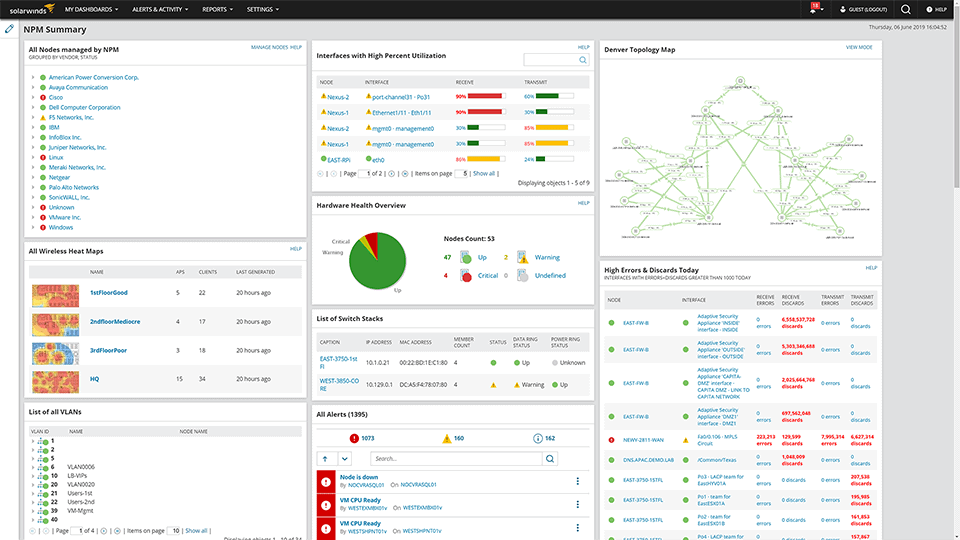
The SolarWinds Network Performance Monitor is the premiere network monitoring software on the market. The SNPM will discover all of the devices on your network and create a map of them within a single hour.
It'due south straightforward to customize how you view your web-based applications using the SNMP. For example, y'all can create different dashboards measuring the performance of your network.
Main Features:
- The SNPM can monitor multiple vendors at in one case
- Look at the whole picture- the SNPM gives you consummate visibility of your network
- The NetPath and PerfStack functionalities make troubleshooting a breeze
- Extremely scalable
- Decrypts SSL near automatically if you need information technology to
Pricing:
All in all, if y'all've got the $two,675 that it takes for a year of SNPM usage, information technology's well worth it. It offers an almost strictly ameliorate experience than Wireshark, with many more functionalities to meliorate your network monitoring. The SolarWinds Network Performance Monitor comes with a 30-twenty-four hours gratuitous trial.
Download the 30-solar day FREE Trial
https://www.solarwinds.com/network-operation-monitor
ii. Paessler PRTG
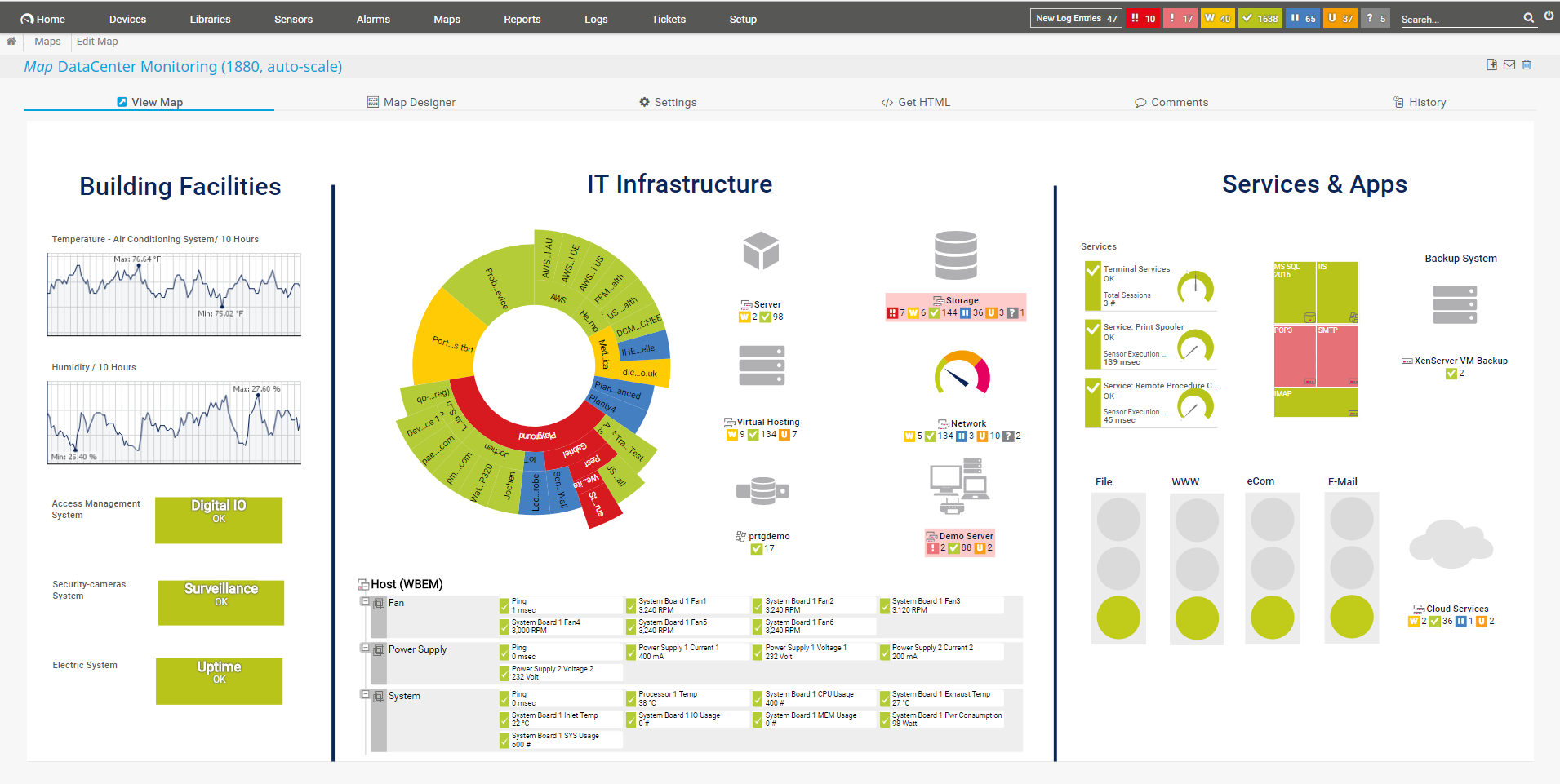
The Paessler PRTG monitor excels at monitoring your It infrastructure from a distance. 1 of its master selling points is how good information technology is at monitoring multiple networks at once.
Chief Features:
- Fully-fledged web interface based entirely on AJAX employing the highest security standards
- SSL-secured access both on-prem and remote
- Fantabulous visualization capabilities assist you lot adjust to issues in your network on the fly
- Multi-network monitoring
The Paessler PRTG is paid on a sensor-based model, letting you only pay for the functionalities you need. With that being said, SSL decryption is a tiny bit more complex than on Wireshark.
3. CloudShark
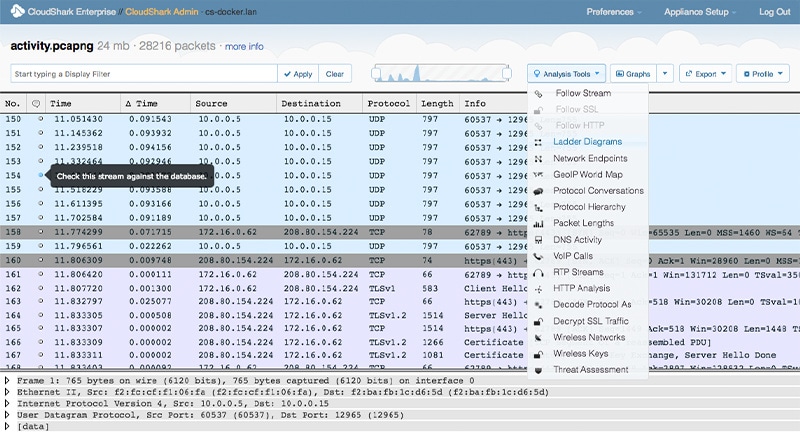
CloudShark tries its all-time to brand analyzing and sharing bundle captures as easy as possible. Information technology aims to exist quicker and more than efficient than Wireshark at solving some of its biggest issues.
- The elevate-and-driblet interface makes it incredibly simple to use
- You can upload your API fundamental
- Information technology can act as a storage space for the files y'all generate using it
- You can get together avant-garde analysis data from your device without any additional software
- Instant linking and so you tin can share your reports with the team.
- Entirely web-based
Cloud Shark boasts a 90-day free trial! Notwithstanding, it is pretty pricey at $4500 a year.
Endmost Words
Wireshark makes the SSL decryption process equally simple as it can get. Unfortunately, cryptography tends to get more and more complex with time. With protocols getting more and more secure, you must take a way to clarify the data coming in correctly.
Wireshark lets you analyze and decrypt all of your SSL traffic with ease, making the whole monitoring process a lot easier. With that existence said, it has its downsides. Wireshark isn't very scalable, so if you're looking for a more than long-term solution, yous might want to change to ane of its alternatives.
Did we forget your favorite Wireshark culling?
How exercise yous prefer to decrypt SSL using Wireshark?
Let united states of america know in the comments below!
crutcherthationdeas51.blogspot.com
Source: https://www.webservertalk.com/decrypt-ssl-with-wireshark/
0 Response to "How to Capture and Read Ssl Traffic"
Post a Comment